
These are books that I’ve read in 2026, as the title suggests. Duh! Of course, since 2026 isn’t over yet, this will be a running blog that I’ll keep updating as and when I finish reading a book.
January
The Widow by John Grisham

I’ve read each and every book that Grisham has written, and I’ve enjoyed most of them. However, his last few have been starkly disappointing, more so when compared to his earlier works. With all of his newer novels, I feel like a substantial amount of the story goes into just building up the plot – upwards of 70% of the story at times. And then the story fizzles out to a hurried ending. I felt the same with The Widow. The premise, as always, is great. The characters are interesting. The friction is created in an intriguing manner, but the ending leaves you wanting for more.
The Widow was again disappointing, but that doesn’t mean I won’t pick up his next book, of course I will; with the hope that maybe the next one will once again have his spark.
Animal Farm by George Orwell

I first read Animal Farm ages ago when I was in college. I was going through a reading slump last year, so decided to pick up some classics. 1984 (I read it in 2025) and Animal Farm were two of them. I don’t remember if Animal Farm resonated with me when I had read it in college, but this time it really did with everything that’s happening in world politics today. The book was written with different politicians and political scenarios in mind back in 1945, but one can easily put current politicians in the characters and they would be a perfect fit. That will probably be true for the years to come as well. No wonder a classic!
Every Day I Read by Hwang Bo-reum

This book was such a joy to read. Pick it up if you’re looking to rediscover the joy of reading or even if you just want to feel more joy about reading for pleasure. The book is a collection of 53 short essays on reading, encapsulating why the author reads every day. And it will make you want you to read every day as well, for sure.
Apart from this, the author also gives you numerous book recommendations that you will add to your reading list. I know I did. My desire to read as well as my reading list have both burgeoned thanks to Every Day I Read.
Never Flinch by Stephen King

This latest by Stephen King starts out in a very chaotic manner. There are multiple storylines and characters to keep up with for a better part of the first half. Sometimes it feels like two or more completely different plots, though of course you know they’ll converge at some point. And oh boy! when they do, it turns into a crazy ride – the type that only King can take you on. Eventually the story does become predictable but it has enough and more going on to keep you engaged.
There’s a killer who seems inspired by Dexter (from the TV show), there’s Holy Gibney (a character who King clearly is very fond of), there are stalkers and cops, there is a hardcore feminist (who King uses to make a cultural and political point), there is an endearing black singer and a lot more. Like I said, there’s a lot going on but Never Flinch is very much a fun read because King holds nothing back, doesn’t bother to be diplomatic while he’s telling you about characters you want to read more about.
February
Vultures by Dalpat Chauhan
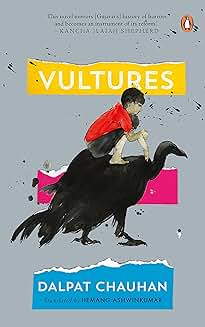
This is a Gujarati novel by Dalpat Chauhan, who is a prominent Dalit writer. I read the English version translated by Hemang Ashwinkumar. The book is set in a rural Gujarat village and narrates the plight of untouchables amidst rampant casteism. For me, what stood out about the novel was the intricate manner by which the author describes the day-to-day lives of people in the village, especially the lower castes.
He goes into great depths to show how they subjected to work under upper caste landowners, the paltry sums and watery food they receive, the constant fear they live in, and yet, stay obligated to the caste structure with the belief that they are fated to live such a life. A very interesting chapter is on how a dead buffalo is skinned and cut before the meat is distributed. Another interesting aspect is the raw sexuality between Iso and Diwali, two leading characters. What I really liked reading was the English translation of common Gujarati phrases – those got me to chuckle. The book is called Vultures to signify how humans are akin to the birds: hungry for blood and revenge.
The Catcher In The Rye by J. D. Salinger

The first time I read this novel, I was a teenager. I re-read it again now, at a time when I have a teenager. I don’t know what appealed to me about the book back then, but I didn’t like it one bit this time. I guess that is how tastes and preferences evolve with time. I had to struggle to get through Holden Caulfield’s godawful weekend. He was annoying the way teens are (even mine can be, at times). Maybe I was able to relate to him when I was a teen, but not one bit when I am in my 40s. Anyway, I’ve been wanting to re-read classics and this one was on my that list. So mostly just something I wanted to tick off.
The Blaft Anthology Of Tamil Pulp Fiction

I’m probably not the right audience for these short stories, which is why I didn’t enjoy all of them as much. But as far as pulp fiction goes, they are right up there. As the title suggests, this is a collection of short stories published by various Tamil writers of pulp fiction. They are easy to read; some easy to predict as well. Don’t have much to say except that they’re a decent way to pass time.
Convenience Store Woman by Sayaka Murata

I’ve mixed feelings about this book. I found it to be quite a weird story, and two very weird characters in Keiko and Shiraha. More so Keiko because I found it hard to believe that someone would be so naive about the world and the people in it. Shiraha was weird but believable, because a lot of men are like he is. But overall, I’m confused about what the book is.
The convenience store often feels like a metaphor for the real world, but is it really? I can understand the bits about people being “foreign objects” or “normal” and “ordinary”. I can understand the bits about people wanting everyone around them to fit their worldview and how an adult should live life by ticking off the right boxes. But I didn’t understand how all this is happening to Keiko after 18 years of working at the store. Should have happened way earlier. The end was predictable and for me, the saving grace of the book was that it’s a short read.
The DOSE Effect by TJ Power

I know, I know, none of us are fans of self-help books. But I also know, a lot of us do read them. I do, every once in a while, and some of them, like The DOSE Effect, turn out to be quite useful. Like all books in this genre, this one is backed by science as well, but what I liked is that it is dumbed down to a very consumable state. I also liked how the book is structured to cover 4 essential chemicals: dopamine, oxytocin, serotonin and endorphin. Many of habits or ideas listed might come off as obvious, but we don’t do them anyway. So, it makes sense to get a reinforcement. I’ve picked up a few habits to incorporate in my day-to-day life after reading this book. Let’s see how well they help me. But overall I liked the book enough to get a copy for my teenage son as well.
Trust by Herman Diaz
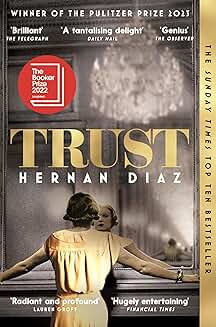
I picked this book up because of its theme: finance, markets, money, business, economy etc. And it did not disappoint. Trust is essentially the story about a New York financier and his wife. What happens to them is narrated through 4 different books within the novel: a novel, an unfinished autobiography, a memoir and a personal diary. As you read the 4 parts, you discover newer aspects of the power couple, not knowing which version to trust or whose version to believe. All of it makes for an intriguing reading with great prose, structure and storytelling. One of the versions also gave me a great idea of how to write fiction myself. Couldn’t have asked for more!
The book also has some amazing quotable lines. Here are my favorites:
“Intimacy can be an unbearable burden for those who realize it makes their world complete.”
“True privacy requires a public facade.”
“Most of us prefer to believe we are the active subjects of our victories but only the passive objects of our defeats.”
March
The Lowland by Jhumpa Lahiri

What a novel! It was the type of novel that made me think wow at several parts of it. The way the places are described, the way the characters are portrayed and the way the story is built – it is all simply sensational. I’m so glad I joined a hook club that was reading this book, otherwise by myself I would have never picked it up. I think what Lahiri does really well is create characters that are very relatable, and/or desirable. I could see my life, in parts, in so many of the people in The Lowland. While it is a heartbreaking story of loss, despair and abandonment, for me it was also a story of hope. That is what I really loved about it.
Chess Story by Stefan Zweig

Chess Story just didn’t work for me. I was left bewildered after finishing this novella, unsure what it was about. Sure, you know it’s not entirely about chess, it’s also about the human mind and obsession, and what all of that can do to one. But I didn’t get the big deal behind this being a classic. The story wasn’t so powerful either. Overall, I found it to be quite bland.
Fat City by Leonard Gardner
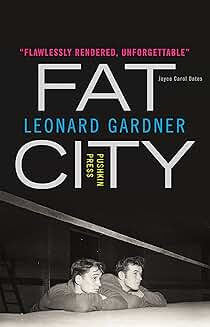
It’s not often that I give up on a book, but this one I had to. I couldn’t read – even after a week of trying multiple times. I wanted to give it a shot because it came across as an interesting story but the first about 30% of the book felt too cliched. A failed boxer down in the dumps, a newbie boxer finding his feet, a rundown boxing coach seeking lost glory – how many times have we read or watched similar stories! A million times, right? And even apart from the that, the novel wasn’t easy or fun to read. Sometimes an author describes everything in too much detail and Gardner does that in Fat City. It put me off in a big way.
Wodehouse At The Wicket by PG Wodehouse
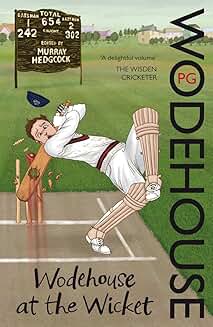
This one isn’t one of the usual Wodehouse works – it’s an anthology that has several stories from his other books. But for any cricket fan, it is fun nonetheless. An easy, quick read in his typical style. What I found most interesting was the introduction chapter that gives a wide glimpse into Wodehouse’s journey as a cricketer himself. I had no idea he played cricket, even at Lord’s! Apart from that some stories miss the mark but nothing to complain about as a reader of Wodehouse’s works.
April
Shantaram by Gregory David Roberts

I re-read Shantaram after almost 20 years and discovered, once again, why I loved the book so much. This is a novel! This is what a novel should be – it should be epic. It should be magnanimous, as Shantaram is, in its storytelling, its characters, its philosophies. Shantaram is a big book – more so when you compare it to newer novels. It is not an easy read, with philosophical interludes and rich characters in every chapter, but it is a story that keeps you engaged and coming back for more. There were times when I had to take a break from it, but every single time, I wanted to end the break and get back to the book. Shantaram, of course, is a book set in Bombay, but it is as much about Indians as any book can be. The fact that it is written by a foreigner and based on his real life experiences makes it even more special. It’s a book that will make you wonder why you’re not experiencing life the way Roberts does – and I don’t mean the crimes, drugs or wars he lives through – but the love, friendships and connections that he keeps attracting by just being open and surrendering to them.
 Saurin Parikh